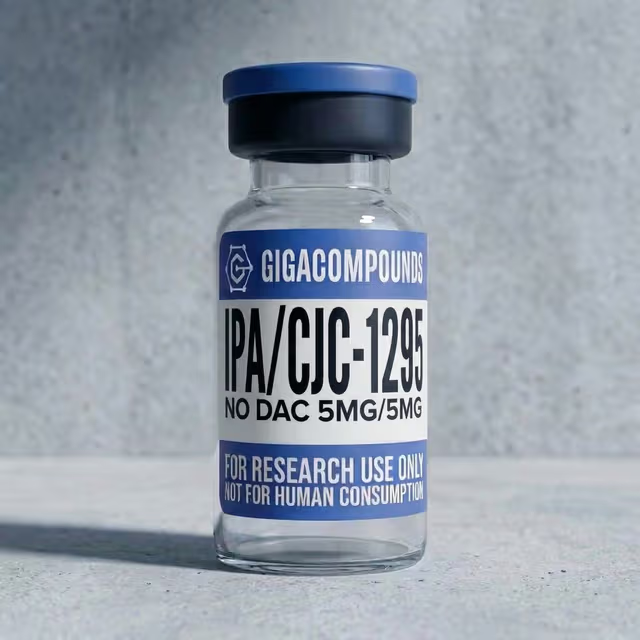
Description
Ipamorelin / CJC-1295 No DAC (5mg/5mg) Lyophilized Powder
Key Points:
- Ipamorelin is a highly selective growth hormone secretagogue receptor (GHS-R1a) agonist.
- CJC-1295 No DAC (Modified GRF 1-29) is a stabilized, 29-amino acid growth hormone-releasing hormone (GHRH) analog.
- The co-administration of these peptides produces a powerful, synergistic dual-axis stimulation of growth hormone (GH) secretion.
- This combination is considered an optimal tool for investigating physiological GH pulsatility and the downstream IGF-1 axis.
- Strictly for Research Use Only (RUO). Not for human or veterinary diagnostic or therapeutic applications.
Overview:
This research-grade combination blend is formulated with 5mg of Ipamorelin and 5mg of CJC-1295 No DAC (Mod GRF 1-29) as a co-lyophilized powder. Research suggests that concurrent activation of both the GHRH and ghrelin pathways elicits a supra-additive (synergistic) GH pulse [cite: source: 54, source: 56]. By closely mimicking endogenous physiological signaling patterns, this 5mg/5mg blend serves as a critical biological tool for researchers investigating neuroendocrine feedback loops, somatotroph function, and metabolic remodeling in controlled experimental models [cite: source: 54, source: 61].
Product Specifications
| Specification | Ipamorelin | CJC-1295 No DAC (Mod GRF 1-29) |
|---|---|---|
| Peptide Class | Ghrelin Receptor (GHS-R1a) Agonist | GHRH Receptor Agonist |
| Sequence / Structure | Pentapeptide: Aib-His-D-2-Nal-D-Phe-Lys-NH2 | 29-amino acid GHRH analog |
| Key Substitutions | N/A | Ala2 (D-Ala2), Gln8, Ala15, Leu27 |
| Molecular Weight | ~711.85 Da | ~3367 Da |
| CAS Number | 170851-70-4 | 863288-34-0 |
Pharmacological Profile and Mechanism of Action
Ipamorelin is a highly selective synthetic pentapeptide designed to mimic the endogenous action of ghrelin. It functions as a targeted agonist of the growth hormone secretagogue receptor type 1a (GHS-R1a), which is located on the somatotroph cells of the anterior pituitary [cite: source: 16, source: 49]. Unlike other first-generation GH-releasing peptides (GHRPs), in vitro and in vivo studies indicate that Ipamorelin stimulates a profound GH release without simultaneously triggering the secretion of cortisol, adrenocorticotropic hormone (ACTH), or prolactin [cite: source: 15, source: 50].
CJC-1295 No DAC, also extensively documented in the literature as Modified GRF 1-29 (Mod GRF 1-29) or tetrasubstituted GRF 1-29, is a synthetic peptide analog of the biologically active 1-29 fragment of endogenous GHRH [cite: source: 59, source: 61]. The molecule incorporates four critical amino acid substitutions: an optical isomer D-Ala2 substitution, along with Gln8, Ala15, and Leu27 [cite: source: 61, source: 65]. The substitution at position 2 prevents rapid enzymatic cleavage by dipeptidyl peptidase-4 (DPP-IV), while the others reduce oxidation and enhance receptor binding affinity [cite: source: 6, source: 60]. These modifications increase the functional half-life of the peptide to approximately 30 minutes, allowing for a discrete, sustained activation of the GHRH receptor [cite: source: 61, source: 64].
Synergistic Dual-Axis GH Secretion
The principal scientific advantage of this blend is the dual-axis synergy achieved by engaging two distinct but convergent intracellular pathways. CJC-1295 No DAC binds to the GHRH receptor, activating the cyclic AMP (cAMP) and protein kinase A (PKA) signaling cascades to stimulate GH gene transcription and exocytosis [cite: source: 56, source: 61]. Concurrently, Ipamorelin binds to the GHS-R1a receptor, activating the phospholipase C (PLC) and protein kinase C (PKC) pathways, which significantly amplifies the GH release while actively suppressing somatostatin, the body’s natural GH inhibitor [cite: source: 10, source: 56]. Clinical and experimental research has demonstrated that this GHRH-GHRP synergy produces an acute, supra-additive GH pulse that is vastly superior to the administration of either peptide alone [cite: source: 14, source: 54].
Research Applications
This 5mg/5mg combination formulation is utilized strictly for laboratory and pre-clinical research. Major applications include:
- GH Pulsatility Studies: Investigating physiological, episodic somatotroph secretory bursts and their regulation by synthetic secretagogues [cite: source: 61, source: 64].
- IGF-1 Axis Research: Tracking downstream hepatic output of Insulin-Like Growth Factor 1 (IGF-1) in response to amplified, pulsatile GH stimulation [cite: source: 44, source: 55].
- Metabolic Modulation Models: Evaluating the impact of synchronized GH pulses on lipolysis, lean muscle tissue hypertrophy, cellular repair, and collagen synthesis in animal or cellular models [cite: source: 56, source: 57].
Storage, Preparation, and Purity
The Ipamorelin / CJC-1295 No DAC blend is supplied as a highly stable lyophilized powder. The unconstituted vial should be kept out of direct light and stored at -20°C (or -80°C for long-term preservation) [cite: source: 37]. Once reconstituted with bacteriostatic water or sterile saline for experimental use, the solution must be refrigerated (2°C to 8°C) to maintain structural integrity. This product has been analytically verified by High-Performance Liquid Chromatography (HPLC) and Mass Spectrometry to guarantee a sequence purity of ≥99% [cite: source: 36, source: 37].
Regulatory Disclaimer: This compound is intended for Research Use Only (RUO). It is not approved for human consumption, veterinary applications, or clinical diagnostic/therapeutic use.
References
- [cite: source: 50] Raun K, Hansen BS, Johansen NL, et al. Ipamorelin, the first selective growth hormone secretagogue. Eur J Endocrinol. 1998;139(5):552-61.
- [cite: source: 48] Jetté L, Léger R, Thibaudeau K, et al. Human growth hormone-releasing factor (hGRF)1-29-albumin bioconjugates activate the GRF receptor on the anterior pituitary in rats: identification of CJC-1295 as a long-lasting GRF analog. Endocrinology. 2005;146(7):3052-8.
- [cite: source: 54] Veldhuis JD, Bowers CY. Determinants of GH-releasing hormone and GH-releasing peptide synergy in men. Am J Physiol Endocrinol Metab. 2009;296(5):E1085-92.
Reviews
There are no reviews yet.